How to Read a Song Form
Many chant pages on this site include a Song Form. It is a short map of the chant: which lines are sung, in what order, and how many times. This Guide explains how to read that map, the meter line that follows it, and the Notes underneath. For sitting at the harmonium and learning a first chant, see the Harmonium for Beginners Guide. For the rhythm markings in the scores, see the Reading Rhythm Guide.
The Lettered Lines
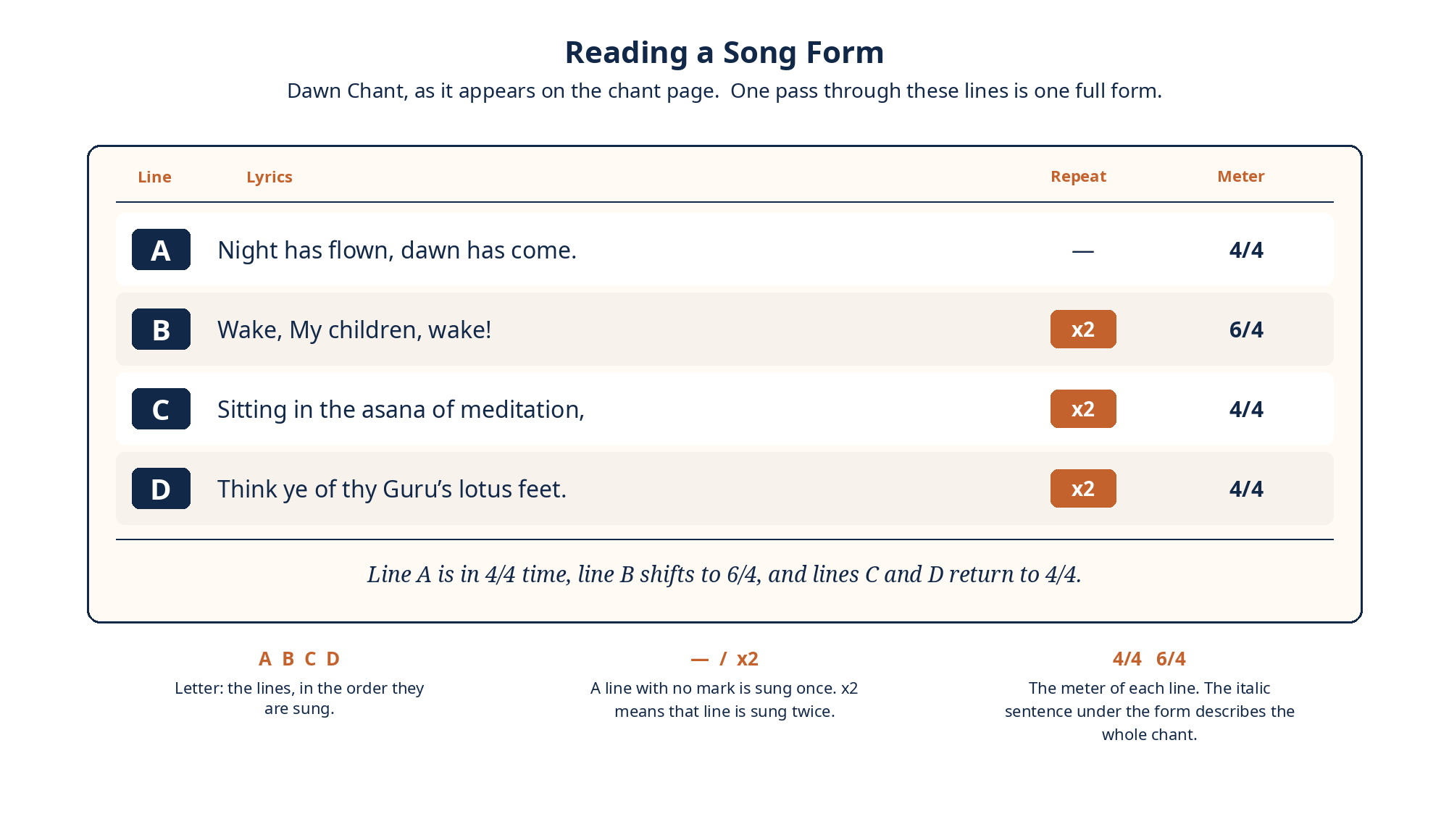
The Song Form lists the chant’s lines as A, B, C, and so on, in the order they are sung.
A letter with a prime, such as B′, is a close variation of that line, not a completely new one. In I Am the Sky, B is “I am the vast blue ocean of sky,” and B′ is “I am a little drop of the sky—.” The two lines begin and end with the same melody; B′ differs only in the middle.
The words after each letter are the lyrics for that line. Read the letters down the page to see the shape of one full form.
What x2 Means
x2 marks an internal repeat: that line is sung twice before you go on. A line with no marking is sung once. The Song Form does not write “once,” and it does not mark the whole chant x2. One pass through the lettered lines is one full form. In kirtan, that form is usually sung several times.
Dawn Chant is a clear example:
A: Night has flown, dawn has come.
B: Wake, My children, wake! x2
C: Sitting in the asana of meditation, x2
D: Think ye of thy Guru’s lotus feet. x2
A has no x2, so it is sung once. B, C, and D are each sung twice.
Today My Mind Has Dived shows why the markings matter. Its form is A x2, B x2, A, C, D x2. A is sung twice at the beginning, but when A returns later in the form it has no x2, so it is sung only once.
The Meter Line: Time Signature and Bar Count
Just under the lettered lines is a short line, often in italics. It tells you the meter (the time signature), the bar count of one full form, and any pickup or unusual feel. The bar count is for one pass through the form, including the internal x2 repeats.
A pickup is a short lead-in before the first full bar. The meter line on O Thou Blue Sky reads: “Begins with a one-beat pickup on ‘O thou.’ A is in 3/4; B and C are in 4/4, with a short bar on ‘heart of hearts.’ 16 bars in mixed meter, asymmetric feel.”
Asymmetric feel means the sections are not all the same length, or a line is repeated a different number of times when it comes back. In I Am the Sky, “The form is 22 bars in 3/4, but it has an asymmetric feel: A is 4 bars sung x2, B and B′ are 4 bars each, and C stretches ‘frozen sky’ over 6 bars.”
First and Second Endings
Some chants use first and second endings, just as the score does. You take the first ending the first time through, then on the repeat you skip it and take the second ending instead. The Reading Rhythm Guide explains how these look in the notation.
O Thou Blue Sky does this in A. As the Notes say: “The first time, ‘beloved Lord?’ leads straight into ‘O thou’ and back to the top of A. The second time, it ends on a short 2/4 bar, ‘loved Lord?’, before B.”
Notes, Sub-Form Loops, and Alternative Forms
The Notes under the Song Form are performance tips: rhythm traps, endings, and ways to repeat part of the chant once the full form is familiar.
A sub-form loop stays with part of the form instead of returning to the top each time. In O Thou Blue Sky, “A good repeat is to loop B and C as a sub-form. B can also be sung an extra time or two, in sets of two, to add devotional emphasis.” In Dawn Chant, once you have gone through the full form several times, “You could loop lines C and D, each sung twice, for a while, or simply keep repeating line D.”
A few chants have an Alternative Song Form. God of Beauty has a standard form of 6 bars in 4/4 and an alternative form of 8 bars in 4/4, with a little more repetition at the end of the line. Use one form or the other in a given rendition, so the group can follow.
Endings, and Free Versus In Time
The Notes often suggest a good ending. In O Thou Blue Sky, “A good ending is to repeat C several times, then end on ‘My beloved Lord, in thy heart of hearts.’” In I Am the Sky, “the most natural ending is to repeat A as you fade out, keeping the intensity of the chant.” In Dawn Chant, the chant ends on “lotus feet” at the end of line D.
Free versus in time describes whether the chant is sung with a steady pulse. He Who Knows is a short, single-line chant. Cosmic Chants marks it Free and gives no metronome marking, but it is sung in time, slowly, so that it still has a free feel. The melody recording on that page is in time at 66 BPM. Its form is 3 bars in mixed meter: 5/4, 3/4, 5/4. The whole line is cycled as a unit; no phrase in it repeats on its own.
When you learn a new chant, read the Song Form and the Notes before you sing it with a group, then listen to the SRF recordings on the chant page to hear how the form is used. The Learning a New Chant Guide walks through that routine.