6 min read
Reading Rhythm
This Guide explains the rhythm markings you will see in the Cosmic Chants scores: how long notes last, how to count them, and how time signatures and repeat signs work. A few familiar chants are used as examples.
Note Values and Rests
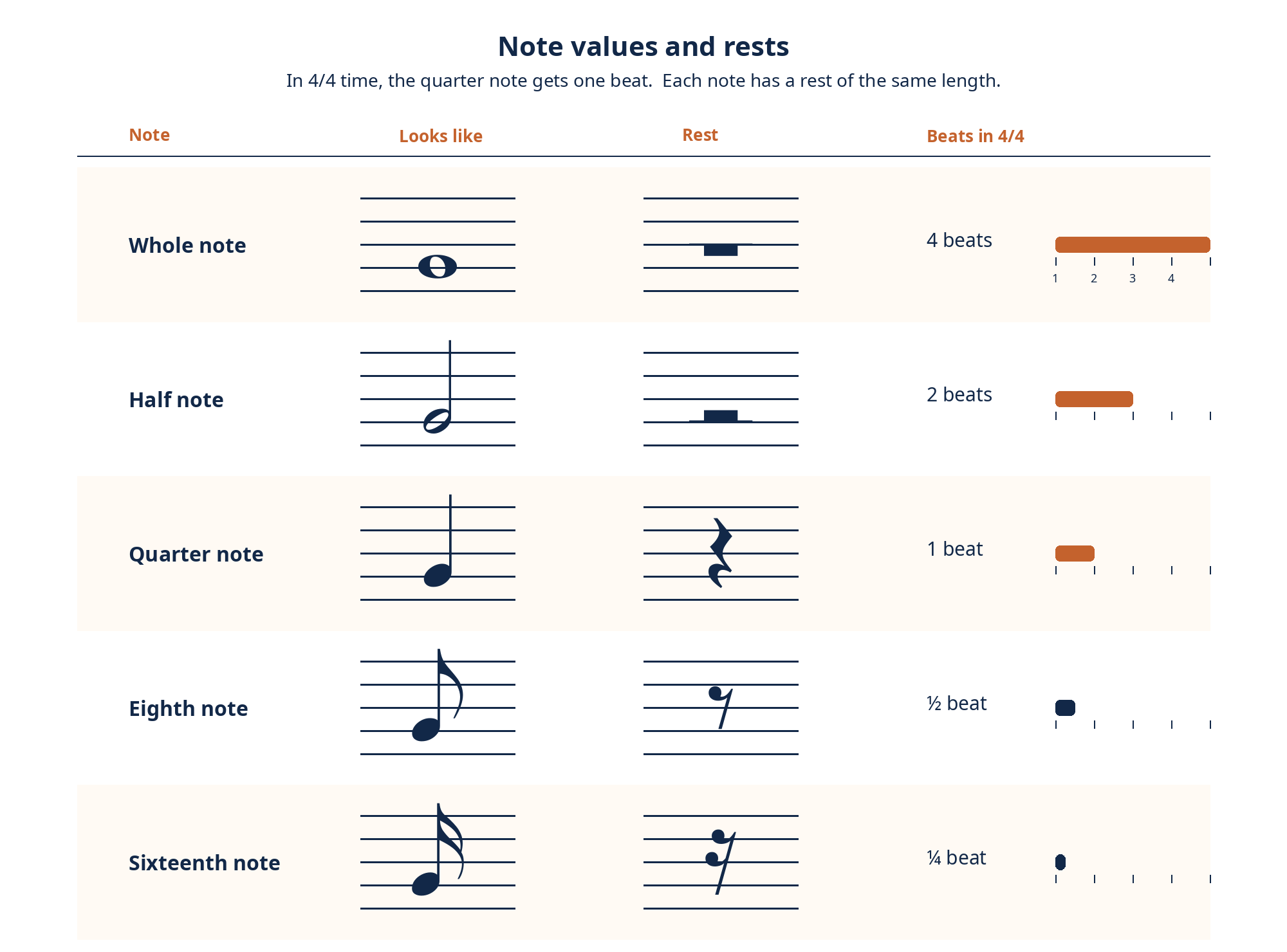
Notes last for different lengths. In 4/4 time, the most common time signature, a whole note lasts four beats, a half note two beats, a quarter note one beat, an eighth note half a beat, and a sixteenth note a quarter of a beat. Each note has a rest of the same length, which is a silence.
Eighth notes are often beamed together in groups, and sixteenths too. The beam does not change the length; it just makes the group easier to read.
Dotted Notes and Ties
A dot after a note adds half of that note’s value. A dotted quarter note lasts one and a half beats: a quarter plus an eighth.
A tie is a curved line connecting two notes of the same pitch. You sing or play the first note and hold it for the combined length of both; you do not strike the second note. A dotted note and a tied note can last the same amount of time. A dotted quarter, for example, sounds the same as a quarter tied to an eighth.
These come up often in Cosmic Chants, and they are easy to smooth into even beats by mistake:
In I Am the Sky, “little” is a quick eighth note (“Lit-”), then “-tle” is a dotted quarter tied to an eighth, coming in just before the beat and held.
In Dawn Chant, “Guru’s” is an eighth note on beat 3 (“Gu-”), then “-ru’s” is an eighth tied to a quarter, coming in just before beat 4 and held through the beat.
In O Thou Blue Sky, “hidden” is a quick sixteenth (“Hid-”), then “-den” is a dotted eighth tied to a quarter, held through beat 2.
Counting
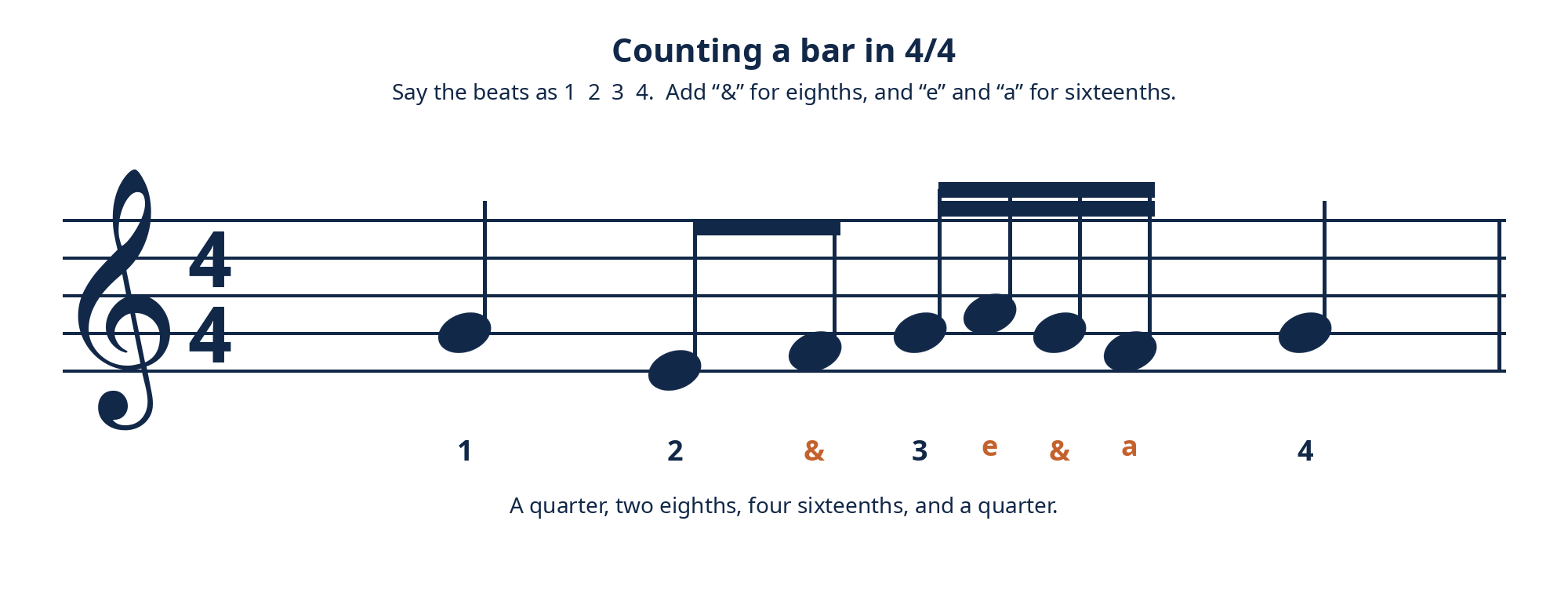
To keep a steady pulse, count the beats out loud or in your mind.
In 4/4, the four beats of a bar are counted 1, 2, 3, 4. When the bar has eighth notes, count the halfway points as “and”: 1 & 2 & 3 & 4 &. When it has sixteenth notes, divide each beat into four: 1 e & a, 2 e & a, and so on.
Time Signatures, Bars, and Pickups
A time signature sits at the start of the chant, and again wherever the meter changes. The top number is how many beats are in each bar (also called a measure). The bottom number is the kind of note that gets one beat: 4 means a quarter note, 8 means an eighth note.
4/4 has four quarter-note beats in each bar. It is the most common meter.
3/4 has three quarter-note beats, with a gentle three-beat feel. I Am the Sky is in 3/4 throughout.
2/4 has two quarter-note beats, so the bars are shorter.
6/8 has six eighth-note beats, often felt as two groups of three.
A pickup is a short lead-in before the first full bar. O Thou Blue Sky begins with a one-beat pickup, “O thou,” and the first full bar of 3/4 starts on “blue.”
Repeat Signs, Endings, and Mixed Meters
A forward repeat sign (two dots to the right of a double bar) and a backward one (two dots to the left) tell you to sing or play that passage again. When first and second endings are marked, you take the first ending the first time through, then on the repeat you skip it and take the second ending instead.
O Thou Blue Sky does this in its opening section: the first ending returns you with the pickup “O thou,” and the second ending is a 2/4 bar, “loved Lord?”
Some chants change time signature as they go. These are often called mixed or odd meters. Dawn Chant starts in 4/4, shifts to 6/4 for “Wake, My children, wake!,” and then returns to 4/4. O Thou Blue Sky moves from 3/4 into 4/4, and its last line uses a 4/4 bar plus a 2/4 bar. When the time signature changes, the new grouping of beats starts at that bar line. Keep counting in the new meter so the group stays together.