
5 min read
Reading Notes
This Guide is a simple introduction to reading melody notes in Cosmic Chants and finding them on the harmonium. You don’t need any music training to begin. For major scales and how to name a key, see the Key Signatures & Major Scales Guide.
The Treble Staff
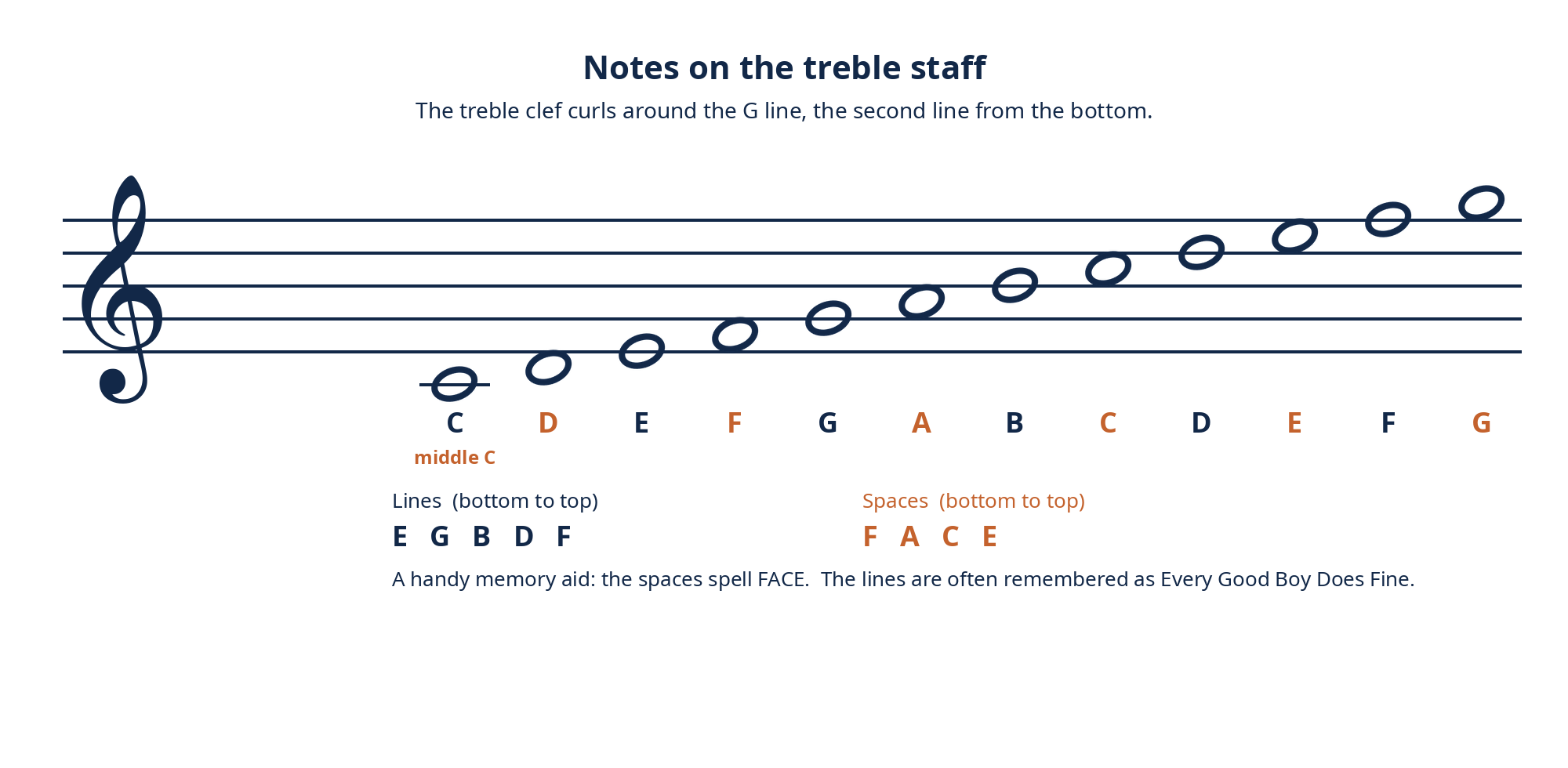
The Cosmic Chants are written on a treble staff: five lines and the four spaces between them. Each line and each space is a different note.
A treble clef (the ornate G-shaped sign) sits at the start of the staff. Its curl wraps around the second line from the bottom, which is the note G.
A common way to remember the names is:
The four spaces, from bottom to top, spell FACE.
The five lines, from bottom to top, are E, G, B, D, and F, sometimes remembered as Every Good Boy Does Fine.
Ledger Lines and Middle C
Notes can also sit above or below the staff on short extra lines called ledger lines.
The first ledger line below the staff is middle C. It is a handy landmark on both the page and the keyboard. Many Cosmic Chants sit around middle C and the notes just above it.
Finding Notes on the Harmonium
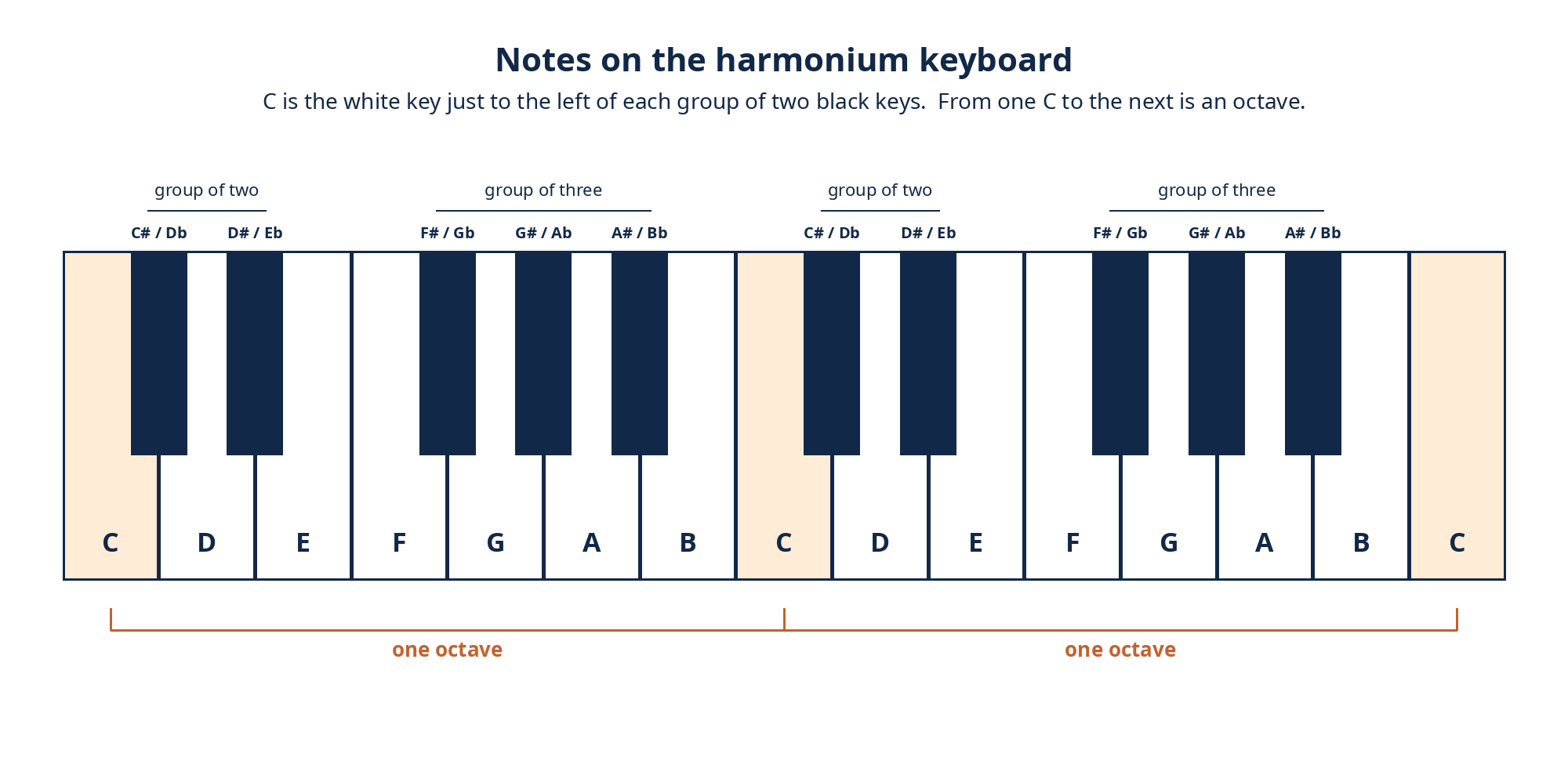
The white keys on a harmonium or keyboard are named C, D, E, F, G, A, and B, then the names start over.
The black keys are grouped in twos and threes, and those groups are the easiest way to find your place:
The white key just to the left of a group of two black keys is C.
The three white keys around that group of two are C, D, and E.
The group of three black keys sits between F and B, with F just to the left of the group and B just to the right.
From any C up to the next C is an octave: the same note name, sounding higher or lower, but otherwise the same.
For sitting at the instrument, pumping the bellows, and learning your first chant, see the Harmonium for Beginners Guide.
Sharps, Flats, and Naturals
The black keys are named with sharps and flats:
A sharp (♯) raises a note by a half step. C♯ is the black key just to the right of C.
A flat (♭) lowers a note by a half step. D♭ is the black key just to the left of D.
C♯ and D♭ are the same black key. The other black keys work the same way: D♯ and E♭, F♯ and G♭, G♯ and A♭, A♯ and B♭.
A natural (♮) cancels a sharp or flat and returns the note to its unaltered pitch, usually a white key. If a sharp, flat, or natural is written in front of a note, it lasts to the end of that bar, unless another accidental changes it sooner.
Whole Steps, Half Steps, and Key Signatures
A half step is the distance from one key to the very next key, black or white. From E to F, and from B to C, are half steps that happen to use two white keys, because there is no black key between them. A whole step is two half steps, for example from C to D, or from E to F♯.
A key signature is the group of sharps or flats at the start of each staff. It tells you which notes are sharp or flat throughout the chant, so they don’t have to be marked every time. For example, O Thou Blue Sky is written in E-flat major, with three flats (B♭, E♭, and A♭) at the start of each line.
How major scales are built, how to name a key from its signature, and the circle of fifths are covered in the Key Signatures & Major Scales Guide.