Choosing Chords for Harmonium
Chords are not necessary for playing the chants well. Paramahansa Yogananda emphasized melody in his renditions of the chants, so when in doubt, it is better to stick with the melody. For those who can play chords tastefully to augment the predominant feeling of a chant, and who want to put in the work to develop that style, chords are permissible. It is best to get feedback from musically skilled persons to verify that your chords are augmenting the chant rather than detracting from it.
This Guide is for those who want to develop that style. It explains how to choose chords that fit a chant and how to play them well on the harmonium, once the melody and a drone feel comfortable. For where chords fit in a leader’s growth, see Growing as a Chant Leader, and for any unfamiliar word, see the Glossary of Musical Terms.
Two things make chords on the harmonium different from chords on the piano, and the rest of this Guide is built around them: the chords must fit under one right hand, and they must move smoothly and legato.
What a Chord Is
A chord is three or more notes sounded together. The basic chord is a three-note chord, or triad: a starting note (the root), the note two letter names above it, and the note two letter names above that. C–E–G is a C major chord; A–C–E is an A minor chord.
Each key has its own family of chords, built on the notes of its scale. They are often numbered with Roman numerals, counting up the scale from the home note. In a major key, four chords do most of the work:
I, the home chord (in C: C–E–G)
IV, built on the 4th note (in C: F–A–C)
V, built on the 5th note (in C: G–B–D)
vi, the relative minor (in C: A–C–E, A minor)
Lower-case numerals mean minor chords. Another chord from the scale, ii (in C: D–F–A, D minor), is also useful.
In a minor key, the main chords are i (the home chord), iv, v or V, VI, and VII. In E minor (the Tamboura Key listed for At Thy Feet), they are E minor, A minor, B minor or B major, C, and D. B major is used when the melody has a D♯; when the melody uses D natural, B minor fits. To find the notes of any key, see Key Signatures & Major Scales and Reading Notes.
One Hand for Melody and Chord
On the harmonium, the left hand pumps the bellows. So unlike the piano, where the left hand can play chords while the right hand plays the melody, everything happens in the right hand: the melody and the chord notes are played together, by one hand.
The usual approach is to keep the melody on top, played with the fourth or fifth finger, and to place the chord notes just below it with the thumb and the second or third finger. This means a good chord is one that fits comfortably under the hand, close to the melody, usually within the span of an octave or less.
Two ideas help here. A chord’s notes can be stacked in any order, and a chord with a note other than the root at the bottom is called an inversion. C–E–G, E–G–C, and G–C–E are all C major. The particular way you arrange a chord’s notes under your hand is its voicing. Choose the voicing that keeps the melody note on top and the hand relaxed. If a chord still won’t fit, play just two of its notes: leaving out the fifth of the chord (G in a C chord) is usually safe.
When the melody dips low, there may be little room below it. Then play fewer chord notes, or simply hold the drone, until the melody rises again. For sitting at the instrument and pumping the bellows, see Harmonium for Beginners.
Moving Smoothly Between Chords
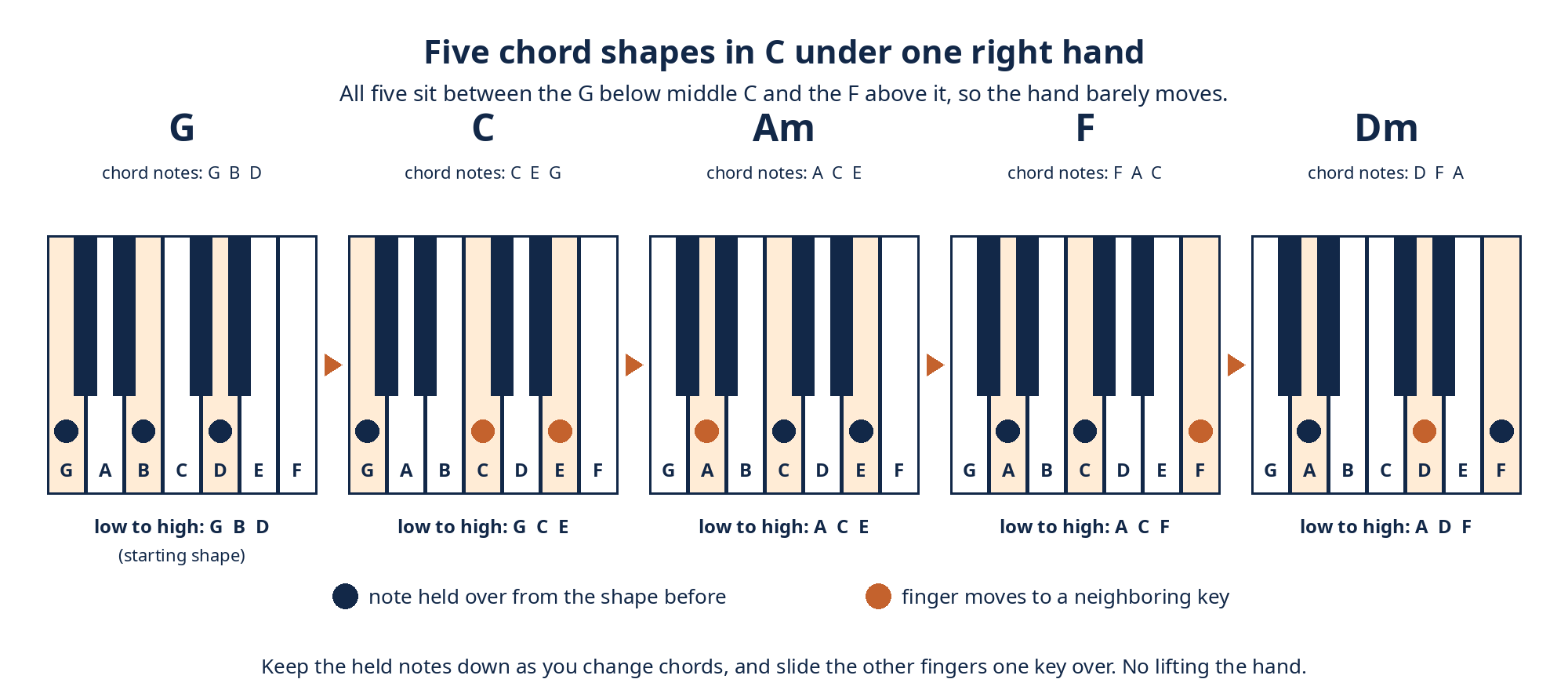
Chords on the harmonium should sound connected, just as the melody does. Lifting the whole hand off the keyboard and putting it back down for each new chord leaves gaps and sounds choppy. Instead, play legato: move from one chord to the next without breaking the sound.
The secret is choosing voicings that are close together. Neighboring chords in a key usually share one or two notes. Keep those common tones held down, and move the other fingers only to a neighboring key. Moving C (G–C–E) to A minor (A–C–E), for example, means keeping C and E down and sliding one finger from G up to A. Musicians call this smooth voice leading.
A few habits help:
Hold common tones through the change, so part of the sound never stops.
Move the other fingers by the shortest path, usually one key.
If a finger must jump, keep at least one other note down while it moves, as an anchor.
Keep the bellows moving steadily through the change, so the volume doesn’t dip.
Practice each change slowly on its own, without singing, until the hand knows the way.
Chords also don’t have to be held as solid blocks. As your playing grows, you can let the fingers move with the melody, so the chord notes shift along with the tune instead of sitting still under it. On the way, the hand may pass briefly through “crunchy” sounds that aren’t simple chords; they aren’t places to stop, but they add a little tension that releases into the next chord. This kind of moving, flowing harmony is a mark of a more advanced player. Start with held chords, and let movement come naturally once they are easy. The chord videos described in the last section are a good way to hear it.
The Harmonium & Vocal Aptitudes for Leading Kirtan Guide describes smooth changes between sections as part of a leader’s skill. Smooth changes between chords are part of the same ease.
Fitting a Chord to the Melody
A chord fits when the melody notes above it belong to it, especially the notes on the strong beats and the notes that are held. Short notes passing between chord notes don’t need their own chord. If a held melody note isn’t in the chord, you’ll hear a clash; try another chord from the key that contains that note.
A simple way to choose: look at the important melody notes in each bar, and pick a chord from the key that contains most of them. Many chants need only one or two chords per bar, and often the same chord for a whole bar or more. Fewer, well-chosen changes usually sound better than many.
Let your ear decide. Play the melody with the chord, listen, and if a chord sounds unsettled where the melody feels at rest, try another.
Start with the Drone, Then Two or Three Chords
Build up gradually. First play the melody over a drone. Then add just the home chord (I or i) and one other chord, often IV or V, and use the drone wherever neither fits. When those feel natural, add a third chord. Many chants sound complete with only two or three chords.
The Tamboura Key on each chant page is a good clue. It names the key and the two drone notes, usually the home note and the note a fifth above it, which are the root and fifth of the home chord. For example, if the Tamboura Key is “C (C, G),” C major is the home chord. Chords that contain C or G (C, F, A minor, E minor, and G) blend easily with the tamboura. A chord with neither note, such as D minor, adds a little more color and tension against the drone. It can sound lovely; just listen that it still supports the melody, and return to the home chord to settle. If you move a chant to a different key, move all the chords by the same amount, as Choosing a Key for a Chant explains.
Keep Chords Quiet, and End at Rest
Chords are there to support the melody, so keep them in the background. On the harmonium, pressing the keys harder doesn’t make a note louder; only the bellows change the volume, and every key you hold sounds at the same level. So the way to keep chords quieter is to use fewer and closer notes: keep the chord just below the melody, use two notes instead of three when the melody is busy, and avoid extra stops or the coupler while chording. If the group can’t easily hear the tune, simplify.
Near the end of a chant, finish on a chord that feels at rest. This is almost always the home chord (I in a major key, i in a minor key), even when the last melody note is not the home note. Hold it while the sound fades gently with the bellows. The ending section of Learning a New Chant has more on bringing a chant to a close.
Finding Your Own Chords by Ear
Experienced leaders often find their chords by ear rather than from a chart. With the principles above in mind, you can do the same:
Stay within the notes of the chant’s key. For a chant in C, that means the white keys only.
Try three-note chords from those notes under the melody, one phrase at a time.
Listen for what supports the melody, and keep what sounds good and settled to your ear.
Play legato, moving between chords without lifting the hand.
Combine the chords with a drone, or with thumb tapping, as feels natural.
Polestar of My Life, written in C with only white keys, is a good chant to try. Watch its “melody twice, chords twice” video, then explore chords of your own under the melody.
Several chant pages have videos that play the melody first and then add chords, so you can hear the difference: Door of My Heart, Dawn Chant, I Am the Bubble, Make Me the Sea, Blue Lotus Feet, Where Is There Love, Satyam Gyanam Antanam Brahma, and Paramahansa Yogananda Jai Guru Jai (YSS variation). On Listen, Listen, Listen, the primary recording includes chords. Listen closely, watch the hands, and use what you learn to develop a tasteful chord style of your own. For chords together with tapping, watch the “full tempo with chords & tapping” video on the Om Kali page.
Listening to the SRF instrumental albums, such as I Am the Sky and The Divine Gypsy, and to the SRF monastics’ kirtans, which are linked on many chant pages, can help train your ear for chord progressions that are tasteful and augment the feeling of the chant.
If in doubt, check your chords with someone who understands music, to verify that they augment the chant rather than detract from it.
Keep It Simple
Remember that chords are not necessary for playing the chants well. Paramahansa Yogananda emphasized melody in his renditions of the chants, so when in doubt, stick with the melody.
If you do add chords, good chords are felt more than noticed. A few chords that fit, played quietly and smoothly under one hand, will support the chant far better than many changes. Start with the drone and one or two chords on an easy chant, let your ear guide you, and add more only as it feels natural. Choose chords with taste, so they augment the predominant feeling of the chant, and ask musically skilled persons for feedback.